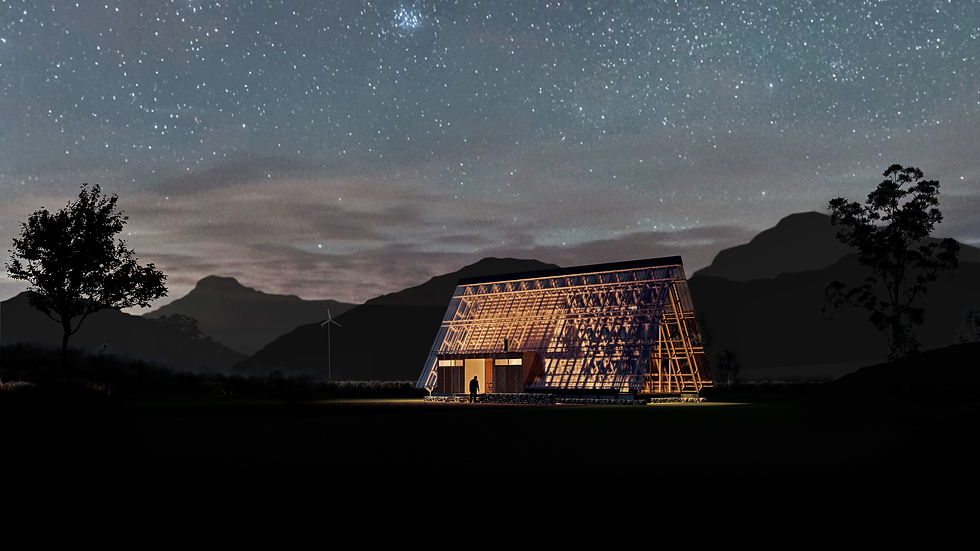
HOUSING
WAI Home 3D Printer Technology
Location:
Auckland NZ
Category:
Housign
Lead Architects:
Sebastian Contreras Rodriguez
Mona Peters
Area:
387 sq. ft Each - 3096 Community
Project Year:
2024
WAI HOME is an award-winning 3D-printed housing proposal developed for the ICON Initiative 99 competition. Rooted in Māori culture—wai meaning water—the project places water at the center of architecture.
Designed for flood-prone areas of Auckland, it proposes elevated, affordable social housing that responds to climate change, flooding, and housing scarcity.
WAI HOME envisions a small community of eight resilient homes, demonstrating how 3D printing can redefine social housing in a climate-uncertain future

WAI HOME
IN MĀORI, “WAI “MEANS “WATER”. Water is a significant and revered element in Māori culture, with deep spiritual and cultural meaning.
The competition, known as "Initiative 99", tasked participants to design a home adhering to a strict budget of $99,000 and utilizing ICON's cutting-edge 3D printing technology for construction.
The winning entry, titled "WAI HOME", designed by MTspace_studio, focuses on addressing the housing crisis in New Zealand's flood zones.
The concept of "WAI HOME" is fully revolves around water, shaping its functionality and design language. From its innovative rainwater collection and storage systems to its robust flood resilience features, water serves as the central theme, intertwining form and function seamlessly.
While the competition attracted hundreds of entries from around the world, Sebastián Contreras and Mona Peters' proposal stood out as the first 3D printed house that rises from the ground on pillars and is specifically designed for social housing in flood zones. This technological innovation and its focus on solving pressing social challenges earned it recognition and the first place in the competition.
GLOBAL CONTEXT
Climate change, primarily a crisis of water, manifests through worsening floods, rising sea levels, as well as droughts. Addressing those challenges requires action at the community and family level. In 2001, floods caused economic losses of more than $82 billion USD worldwide, which is almost one third of the losses from natural catastrophes, and, according to the Swiss Re Institute, is affecting almost a third of the world’s population. In addition to the threat of flooding, reports from the Intergovernmental Panel on Climate Change, anticipate ocean rises of 10 to 30 inches (26 to 77 cm) by the year 2100, should temperatures rise by 1.5 °C. Another analysis, leaning towards a higher end, predicts a 26-inch (65 cm) rise by the century’s end based on NASA and European data. Those studies clearly demonstrate the urgent need for flood resilient housing.
LOCAL CONTEXT
In New Zealand, the daunting challenge of flooding, exacerbated by rugged terrain and climate change, has led to over 80 damaging floods in the past 50 years.
Auckland’s April 2023 flood recovery alone, cost up to 2 billion USD. Intensified by heavy rainfall and mountainous moist air, flooding requires immediate strategies for mitigation and resilience. Paradoxically, climate change also heightens drought frequency in New Zealand, causing annual water shortages all over the country.
Research from NIWA, the National Institute of Water and Atmospheric Research, warns of worsening situations in all of the above events due to climate change, emphasizing the urgent need for decisive action.
Concurrently, a chronic housing crisis spanning four decades, as highlighted by Human Rights Commissioner Paul Hunt, burdens families, leading to mental health and living standard issues. Homelessness affects over 100,000 people in NZ in 2023, and is exacerbated in Auckland’s flood-prone areas.
PROJECT DESCRIPTION
The construction industry is in a state of stagnation, clinging to age-old methods that have persisted for over a century. Recognising the urgent need for innovation, we advocate a paradigm shift through the implementation of 3D printing technology in residential construction. This transformative approach not only fits the contemporary needs of our society, but also addresses the pressing environmental concerns of our planet.
In the midst of the global challenges posed by climate change, we face a dual problem, the water crisis as well as the pressing need for social housing. WAI-HOME is prepared to address these issues by proposing the construction of social housing in flood-prone areas. The strategy focuses on New Zealand and in particular on the city of Auckland, which is a hotspot for both flood risk and a shortage of social housing.
In response to data from the New Zealand Ministry of Social Development showing the group in most urgent need, WAI-HOME is designed to meet the specific requirements of people over the age of 25, living independently or with a child. By responding to the housing needs of this demographic, we aim to have a substantial impact on improving the overall resilience of society in the face of the challenges associated with the housing shortage.
WAI-HOME envisages the construction of eight houses in a designated print area. These homes are designed to optimise the use of space, providing a cost-effective solution for comfortable living. Each 387 sq. ft. home consists of a thoughtfully laid out living room/kitchen, a cosy bedroom, a spacious bathroom and a loft space for a child’s bedroom or additional storage. To seamlessly integrate the indoor and outdoor spaces, each home has a terrace that serves as a connection point to the community life of the neighbourhood.
Affordably priced at less than $99,000, our proposal not only responds to the critical need for affordable housing, but also conforms to the principles of sustainable and efficient urban development.
We can explain the design with the following operations. These operations aim to respond effectively to the need for safe, comfortable, sustainable and beautiful housing.
-
Elevation for Flood Zones: Elevating the house on pillars ensures resilience in flood-prone areas, protecting the structure from potential damage.
-
Rainwater Harvesting Design: The house incorporates a rainwater harvesting system, capturing and utilizing rainwater for sustainable water supply within the dwelling.
-
Social Housing Design: Aligned with Kianga ora statistics (New Zealand’s social housing agency), our design caters to the needs of one person or a single parent with a child, contributing to social housing initiatives in New Zealand.
-
Cost-Effective Construction: The construction cost is optimized based on the square meter per house, with each house valued at an affordable $99,000.
-
Continuous Printing Process: The house is meticulously designed to be printed without interruption, optimizing the efficiency of the printing machine.
-
Optimized Area for Community Living: We maximize the area of impression to propose a community of 8 houses, fostering a collective and interconnected living environment.
-
Intermediate Community Area: All houses feature an intermediate area, fostering community interactions between neighbours. This intentional separation between private and public spaces enhances the sense of community and shared living experience within the city.
-
Flexibility for Two-Bedroom Configurations: The design allows for the seamless joining of two houses, creating two-bedroom configurations for increased versatility and accommodation options.
-
SIP Panel Efficiency: The use of SIP (Structural Insulated Panel) in the floor and roof ensures swift installation and high thermal efficiency, enhancing sustainability.
-
Façade for Directed Rainwater Flow: The façade is strategically designed to channel rainwater toward the garden, contributing to efficient landscaping and water conservation.
In conclusion, WAI-HOME transcends traditional housing standards, offering an innovative and sustainable solution to the challenges posed by flood-prone areas. By integrating elevated housing, terraces and cutting-edge roof design for water harvesting, we aim to not only provide safe and affordable housing, but also contribute to the long-term resilience and well-being of communities and the environment with science and technology.
Tecnical Drawings


Sustainable Technical Data and Design Drawings