
HOUSING
Social Craft Rural Home
Rural housing in Bogotá lacks dignity: it is precarious, thermally inefficient, and reinforces poverty, accelerating rural–urban migration and the abandonment of agricultural life. Despite the city being largely rural, environmental restrictions demand new ways of inhabiting the land responsibly.
This project rethinks rural housing as a resilient habitat—a dwelling that produces food, generates heat, adapts over time, and strengthens community life while respecting vernacular traditions.
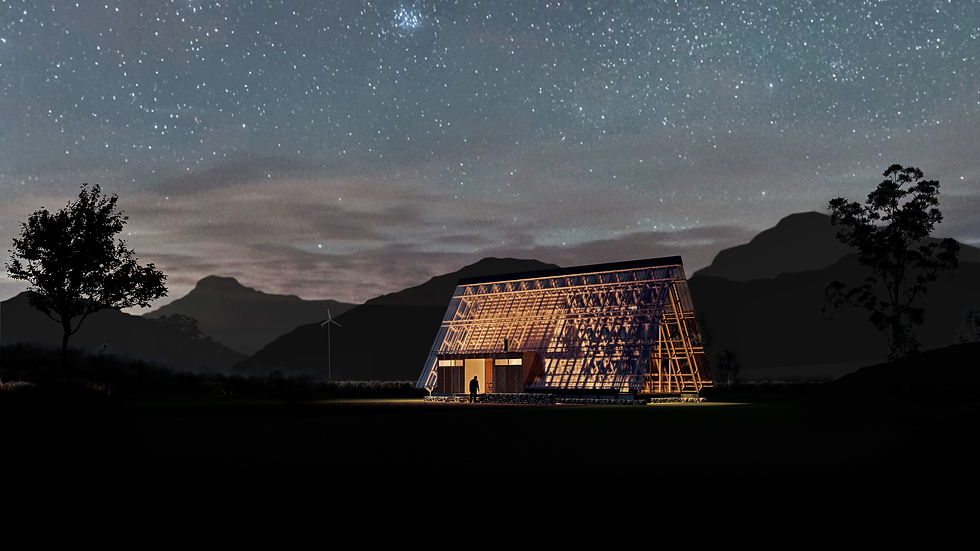
The proposal is based on the Thermal Roof: a habitable roof that merges house and greenhouse into a single productive, social, and climatic structure. Inspired by ancestral architectures, the roof becomes the essential element of dignified living.
Through a simple, efficient structural system, the project addresses both the qualitative and quantitative deficit of rural housing in Bogotá.
Location:
Sumapaz - Bogota - Colombia
Category:
Vivienda Rural
Lead Architects:
Sebastian Contreras Rodriguez
Area:
60 m2
Project Year:
2019

MEMORIA
The panorama today of rural housing as an architectural solution is non-existent, apart from private initiatives to extract ideas from academia and other entities that promote the issue, the housing project that is built in rural territories is devoid of all dignity.
Housing on vulnerable lands, overcrowded materials with no thermal response, intermittent electricity, improvised sanitary systems, are some of the problems with which the peasant lives on a daily basis. This means that when we talk about rurality we have a direct image of poverty and lack of opportunities, which has unleashed the rural-urban exodus and the abandonment of productive forestry and agricultural activities essential for family sustenance.
Approximately 75% of Bogotá's territory is rural, bordering the Sumapaz moorland, according to the District's characterization of the land in the capital. This territory is equivalent to 166,000 rural hectares, and of these only 35,000 are suitable for agricultural activities. The remaining hectares were declared protected, where the exploitation of the land for agriculture is prohibited.
CONCEPTUAL STRATEGY.
This scenario opens the opportunity to rethink the rural housing in Bogotá, from the idea of the resilient habitat, this means a housing that as a principle adapts and overcomes the mentioned adversities producing its own food, heating its interior, growing together with its inhabitants, respecting its architectural and spatial (vernacular) traditions and allowing to be part of a community.
We propose as a conceptual strategy the union between: heat / energy generation and the habitable structure, Termo Techo.
PROJECT STRATEGY.
A Greenhouse is not only a closed space structure covered by transparent materials, it is also a covered patio for rainy seasons, a place to produce and take care of our food, a space for family and community meetings, a thermal device that heats a house in a safe and efficient way.
Thus we also believe that a roof is a habitable structure, a place, a spatial surface that protects from the inclemency of the weather, it is what people claim in the streets, an essential element when we think of a house. Apart from being built of various materials, it represents a desire to live in dignity. A roof is a primitive element typical of our ancestral cultures; the Maloca, Ruca, Choza, are spaces built mostly as a roof. The Roof is the spatial cultural essence from which we support this project.
We design a house as a thermal roof, which gives shelter inside to the relationship between the productive and daily life of today's peasant.
The proposal is based on an elemental principle of support that allows the construction of a covered living space by means of two inclined planes supported by each other forming a traction triangle. The steel structure made up of triangular frames shapes the volume of the House-Greenhouse and stiffens the roof.
We believe that if we respond to the group of variables through a thermal, adaptable, communitarian, productive and resilient proposal, we will come closer to mitigating the quantitative and above all qualitative deficit of rural housing in Bogotá.



Human and Humanitarian Architecture Studio
Follow me
Stay in Touch
Privacy & Cookies Policy © 2026 HAND